What Does Co-Broke Mean in Malaysia? How the Fee Is Split and 6 Rules for Agents 2026
Property Lab editorial teamPublished 11 min read
Key points
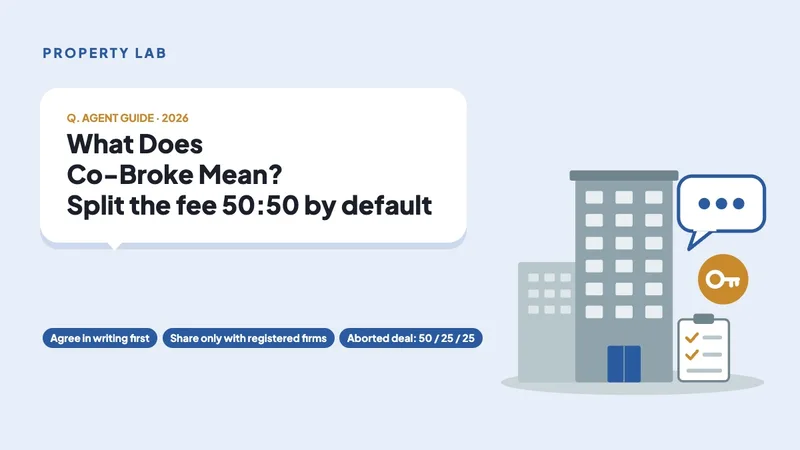
- Under statement 7.2.5 of the Malaysian Estate Agency Standards, a co-broke fee is shared 50:50 by the listing agent and co-agent unless agreed otherwise in writing.
- If a co-broke deal in Malaysia is aborted, MEAS 7.2.6 splits the forfeited amount 50% to the client, 25% to the listing agent and 25% to the co-agent.
- Rule 91 of Malaysia's Estate Agents Rules 1986 bars registered estate agents from sharing fees with anyone who is not a registered valuer, appraiser or estate agent.
Contents
- What does co-broke mean in Malaysia?
- How is co-broke commission split in Malaysia?
- Does co-broke cost the seller, buyer or landlord more?
- 6 co-broke rules agents in Malaysia should follow
- What happens to the co-broke fee if the deal falls through?
- Can one agency act for both the buyer and the seller?
- Can you co-broke with an unregistered agent or pay a finder's fee?
- How to set up a co-broke deal in Malaysia: 5 steps
- Where can agents find co-broke listings for Japanese buyers and tenants?
- Frequently Asked Questions
In Malaysia, co-broke means two registered estate agency firms working one deal together: the listing agent has the property, and a co-agent brings the buyer or tenant. The official name is co-agency. Unless both firms agree otherwise in writing, the Malaysian Estate Agency Standards split the fee 50:50, and the terms must be in writing before any work starts.
Co-broke (co-agency) is a written deal between a listing agent and a co-agent from another registered firm. The client pays one fee, and the two firms share it, 50:50 by default.
Agents may share fees only with other registered estate agents, never with an unregistered "agent" or a friend who found the buyer.
Key numbers (as at November 2026)
- Default co-broke fee split50:50
- Aborted deal, % to client / listing agent / co-agent50/25/25
- Maximum agent fee on a sale3%
- Minimum agent fee on a saleRM1,000
- Top letting fee in months' rent, tenancy up to 3 years1.25
- Service tax on agent fees8%
Also called: co-broke = co-broking = co-agency (the term in the Malaysian Estate Agency Standards, MEAS) = conjunctional arrangement (Rule 92 of the 1986 Rules); listing agent = the firm appointed by the owner; co-agent = the firm that introduces the buyer or tenant; LPEPH = Lembaga Penilai, Pentaksir, Ejen Harta Tanah dan Pengurus Harta (BOVAEP in English).
What does co-broke mean in Malaysia?
Co-broke in Malaysia is a co-operating agreement between a listing agency firm and a co-agency firm that introduces a buyer or tenant for a sale, rental or lease. That is how Standard 7 of the Malaysian Estate Agency Standards (MEAS) defines co-agency.
The two sides have different jobs:
- Listing agent: holds the owner's appointment, sets the asking terms and decides how long the co-agency offer lasts.
- Co-agent: finds and brings the buyer or tenant, and works through the listing agent rather than around it.
"Co-broke" is the everyday word. In 2016, the president of the Malaysian Institute of Estate Agents (MIEA) told EdgeProp the institute prefers "co-agency", because "broking" is not a term for licensed agents. The board's standards and Rule 92 also use co-agency.
On listing sites you also see the labels "co-broke" and "no co-broke". They are not legal terms. In plain words, they show whether the listing agent is open to sharing the fee with an agent who brings a buyer, so ask the listing agent before you arrange a viewing.
Source: MEAS 3rd edition, Standard 7 (copy hosted by MIEA); EdgeProp, 6 Dec 2016
How is co-broke commission split in Malaysia?
The standard co-broke commission split in Malaysia is 50:50 between the listing agent and the co-agent, under MEAS statement 7.2.5. The two firms may agree a different split, but MEAS 7.2.6 says any change from 50:50 must be agreed in writing between them.
Here is how one fee splits on an illustrative RM500,000 sale where the owner agreed a 2% fee:
| Split agreed | Listing firm | Co-agent firm |
|---|---|---|
| 50:50 (default) | RM5,000 each | |
| 60:40 (in writing) | RM6,000 | RM4,000 |
Illustrative: RM500,000 price and a 2% fee of RM10,000 are our assumptions. The fee scale allows up to 3%, which would be RM15,000 here. Service tax at 8% (RM800 on a RM10,000 fee) is charged on top by firms registered for SST.
Illustrative figures: a RM10,000 fee on a RM500,000 sale, and a RM8,000 deposit forfeited before the sale agreement, split under MEAS 7.2.5, 7.2.6 and 4.2.7.
The 50:50 rule is about the two firms sharing one fee. It does not set what each firm pays its own negotiator.
What this means: if nothing is written, the default is half each. If you want 60:40 or a flat sum, get it signed before the viewing.
Source: MEAS statements 7.2.5 and 7.2.6; LPEPH scale of fees; Customs SST industry guides
Does co-broke cost the seller, buyer or landlord more?
Co-broke does not add a second fee for the owner in Malaysia: the owner pays the listing firm one fee, and the listing firm shares it with the co-agent. The fee itself is still capped by the board's scale, at 3% of the price for a sale, with a minimum of RM1,000.
The 1986 Rules back this up. Rule 89 says an estate agent may charge fees only to the person who appoints him, and not to more than one party in any one transaction. The co-agency letter template in MEAS has the co-agent paid only after the listing firm receives its fee from the vendor.
For rentals, the scale allows up to 1.25 months' gross rent for a tenancy of up to 3 years, with a minimum of 1 month. On a RM3,000 a month unit, that is RM3,000 to RM3,750, so a 50:50 co-broke on a one-month fee gives each firm RM1,500.
The board's letting scale does not cover serviced apartments. For a serviced apartment, the letting fee is whatever the owner and the firm agree, so put the amount in writing.
The board's FAQ says the agent's fee is due on signing the sale and purchase agreement (SPA) or the tenancy agreement. MEAS Standard 4 adds that for a conditional agreement, the fee falls due once the last condition is met, unless the client agreed in writing to other terms.
Source: Valuers, Appraisers and Estate Agents Rules 1986, rule 89; LPEPH fees page; LPEPH FAQ
6 co-broke rules agents in Malaysia should follow
Six rules from the board's standards set out how a co-broke should run in Malaysia. MEAS splits each standard into mandatory "statements" and non-mandatory "explanations", so the clause numbers below show which is which.
- Sign before you start: both firms agree the co-agency terms in writing before any work (statement 7.2.1 and Rule 92(2)). The agreement is signed by each firm's registered estate agent (7.2.7), not just by negotiators.
- Set an end date: the listing agent decides the expiry date. The co-agency ends then, when the listing ends, or when both firms agree (7.2.2).
- Half each unless written: the fee is shared 50:50 unless both firms agree another split in writing (7.2.5, 7.2.6).
- Do not go around the listing agent: the co-agent may not solicit the same appointment from the owner during the agreement (statement 7.2.3). The explanations add that viewings and dealings go through the listing agent, and that neither side contacts the other's client directly.
- Disclose the deal details: on entering the co-agency, the listing agent tells the co-agent about the property, the earnest deposit, the fee, when the listing agent gets paid and how the client pays (7.2.8).
- Deposit goes to the stakeholder: either agent may collect the buyer's earnest deposit, but only the stakeholder the client authorised may hold it, unless the client agrees otherwise in writing (7.2.4).
One more explanation is worth knowing. Under 7.3.2.6, if the listing firm has already shown the property to the buyer's spouse, employee or representative, the co-agent gets no fee unless it disclosed the buyer's identity to the listing agent first.
Send the listing agent your buyer's name before the first viewing, and keep the message. It is the record that the buyer is your introduction.
Source: MEAS Standard 7, statements and explanations; 1986 Rules, rule 92(2)
What happens to the co-broke fee if the deal falls through?
If a co-broke deal in Malaysia is aborted, MEAS 7.2.6 splits the abortive fee or forfeited amount 50% to the client, 25% to the listing agent and 25% to the co-agent. Standard 4 then limits what the firm may claim, depending on who pulled out and when.
| Who pulls out, and when | Firm may claim |
|---|---|
| Client, after a binding SPA | Full fee |
| Other party, before the SPA | Capped at 50% |
| Client, before the SPA | Same |
The cap is 50% of the full fee or 50% of the forfeited or earnest deposit, whichever is lower, plus disbursements (MEAS 4.2.6 to 4.2.8). "Binding" means an unconditional SPA or tenancy agreement, or a conditional one whose conditions are all met.
Take the illustrative sale again. The buyer pays a RM8,000 earnest deposit, then walks away before the SPA, and the seller keeps it. Half the fee would be RM5,000 and half the deposit RM4,000, so the firm side is capped at RM4,000: RM2,000 each for the listing agent and the co-agent, and RM4,000 stays with the seller.
An earnest deposit is the client's money until the deal is done. A firm may deduct its fee from the deposit only after an unconditional SPA or tenancy agreement is signed, and only with the client's prior written consent (MEAS 4.2.12).
Source: MEAS Standard 4 (4.2.6 to 4.2.12) and statement 7.2.6
Can one agency act for both the buyer and the seller?
Under Rule 93(1) of the 1986 Rules, a registered estate agent may not act for one party if the other party is represented by another registered estate agent from the same firm. Rule 93(2) allows a related or affiliated firm on the other side only with the parties' knowledge and prior written consent.
The board's online Code of Conduct puts it more loosely, allowing the same firm on both sides "with the knowledge and consent of the parties". The two texts differ, so follow the stricter one and ask the board if a deal depends on it.
The Code of Conduct also says a registered estate agent may not accept fees from more than one client in any one transaction.
Source: LPEPH Code of Conduct; 1986 Rules, rule 93 (copy hosted by MIEA)
Can you co-broke with an unregistered agent or pay a finder's fee?
No. Rule 91 bars a registered estate agent in Malaysia from letting anyone who is not a registered valuer, appraiser or estate agent permitted to practise estate agency share in its fees or commissions. The board's Code of Conduct says the same.
Act 242 is just as clear from the other side. Only registered estate agents may practise estate agency for a fee, and an unregistered person cannot go to court to recover one. Section 30 sets a fine of up to RM300,000, up to 3 years in prison, or both.
- Friends and "freelancers": a person with no REN or REA registration cannot take a share, even if they found the buyer.
- Referral fees from lawyers: Notification 4/2024 says Rule 90 bars agents from taking third-party commissions, such as a solicitor's referral fee, without the client's written consent.
- Before you share: look up the other agent and firm on the board's register. Our guide "Is Your Property Agent Real? 4 Steps to Check a REN in Malaysia 2026" shows how.
Source: Act 242, ss 22C and 30 (Low & Partners reprint); LPEPH Notification 4/2024; LPEPH register search
How to set up a co-broke deal in Malaysia: 5 steps
- Check the other side: search the other agent's REN or E number and the firm's E (1) number on the board's register, and ask whether the listing is exclusive or general.
- Write the letter: MEAS includes a co-agency letter for sales and one for rentals. Each states the fee share in percent, when it is paid, who holds the earnest deposit, and that neither side's negotiators contact the other's client.
- Register your buyer: send the buyer's or tenant's name to the listing agent before the viewing, and arrange viewings through the listing agent.
- Keep each other updated: both firms report progress on the negotiation, and offers go through the listing agent.
- Invoice when it is due: the listing firm collects the fee when the SPA or tenancy agreement is signed and pays the co-agent's share promptly, as the MEAS explanations ask.
The board's sale template also says all other terms follow Act 242, the 1986 Rules and the MEAS. Copying that line into your own letter keeps both firms on the same rulebook.
Where can agents find co-broke listings for Japanese buyers and tenants?
Property Lab, the site publishing this guide, lists Malaysian homes in Japanese and passes Japanese enquiries to the agent in charge. Its page for agents says listing is free, and that co-agency is welcome with the commission agreed up front, deal by deal.
That fits the MEAS rule of agreeing terms in writing before any work. Agree the split for each unit before the first enquiry is passed on.
Source: Property Lab, For agents (read 24 Nov 2026)
List them on Property Lab at no cost, and settle the co-agency split for each unit before work starts.
Frequently Asked Questions
What is co-broke in simple words?
One agent has the property, another agent has the buyer or tenant, and the two firms agree to close the deal together and share the owner's fee.
What does "no co-broke" mean on a listing?
It signals that the listing agent is not offering to share the fee. A buyer can still contact that agent directly, and an agent can ask whether the owner would allow co-agency.
Is co-broke commission always 50:50 in Malaysia?
Half each is only the default. Any other split is allowed if the two firms put it in writing.
Who pays the co-agent?
The listing firm does, out of the fee it receives from the owner. The buyer or tenant does not pay the listing firm's fee.
Is co-broking legal in Malaysia?
Yes, between registered estate agency firms. The board's own standards set out how co-agency works, and Rule 92 asks for its terms in writing.
Can a REN co-broke without their agency?
No. A negotiator works under a registered estate agent and cannot act on their own, and MEAS has the co-agency agreement signed by each firm's estate agent.
Do I need a written co-broke agreement for a rental?
Yes. The written-terms rule covers sales and rentals alike, and MEAS has a separate co-agency letter for rentals.
What does co-broke mean in Chinese?
A plain Chinese way to put it is 合作分佣: working together and sharing the commission. The official English term is co-agency.
The MEAS, the 1986 Rules and the fee scale can be amended, so check the latest wording on lpeph.gov.my before you rely on a clause here. We read the MEAS and the Rules from copies hosted by the Malaysian Institute of Estate Agents.
This page is general information, not legal advice. Fees and splits in the examples are illustrative. Ask the board or a lawyer before you act on a disputed co-broke fee.
Sources
- Malaysian Estate Agency Standards, 3rd edition 2020 (Standards 4 and 7) — Board of Valuers, Appraisers, Estate Agents and Property Managers (copy hosted by MIEA)
- Valuers, Appraisers and Estate Agents Rules 1986, rules 89 to 93 — Malaysian Institute of Estate Agents (copy)
- Code of Conduct — Board of Valuers, Appraisers, Estate Agents and Property Managers
- Scale of fees — Board of Valuers, Appraisers, Estate Agents and Property Managers
- Notification 4/2024: Prohibition Against Demanding or Obtaining Referral Fees From Solicitors — Board of Valuers, Appraisers, Estate Agents and Property Managers
- Co-agency arrangements, trending now in a slow market — EdgeProp
General information only, not legal, tax or investment advice. Rules and rates change; check the official source linked below before you act.
Related guides
All guides →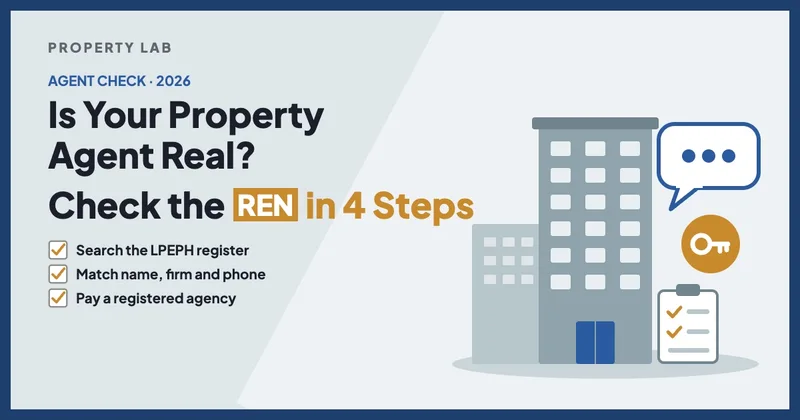
Is Your Property Agent Real? 4 Steps to Check a REN in Malaysia 2026
Law, tax & titleProperty Lab editorial team · 13 min read
Property Deal Too Good to Be True? 7 Scam Signs to Check in Malaysia
Law, tax & titleProperty Lab editorial team · 11 min read
Can You Keep a Dog or Cat in a Malaysian Condo? Pet Rules and 6 Checks
Law, tax & titleProperty Lab editorial team · 10 min read
Related news
All news →- Policy & regulationNationwide
Miti to advise data centres against hosting US-blacklisted firms
Free Malaysia Today · - Policy & regulationKuala Lumpur
Even BN funded KLSCAH, Hannah Yeoh tells Parliament amid RM1,000 land premium row
Malay Mail · - Policy & regulationKuala Lumpur
Duta Enclave valuation followed Land Acquisition Act, court told
Free Malaysia Today · - Policy & regulationNationwide
No hike in water tariffs to meet data centre needs, deputy minister says
Free Malaysia Today ·
Homes on Property Lab
See all homes →BangsarOne Eleven MenurungPrice on request
1–3 beds · 100–220 ㎡ · Bangsar
Bangsar12 KapasPrice on request
1–3 beds · 111–190 ㎡ · Bangsar
Bukit BintangPavilion SuitesPrice on request
1–3 beds · 65–180 ㎡ · Bukit Bintang MRT
KLCCThe Ritz-Carlton ResidencesPrice on request
1–4 beds · 95–398 ㎡ · Bukit Nanas Monorail